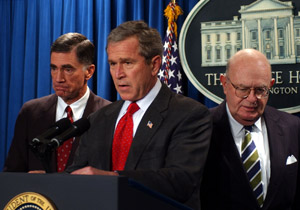
President Bush formed the commission last February and put Judge Laurence Silberman, right, and former senator Chuck Robb in charge. (AP)

The WMD Commission and intelligence reform
ASK THIS | March 28, 2005

A new commission report on the failures of U.S. intelligence should raise questions about government accountability and the feasibility of intelligence reform, writes Steven Aftergood of the Federation of American Scientists.


By Steven Aftergood

saftergood@fas.org


Q.  Do Bush Administration officials bear any responsibility for their public representations of the inaccurate intelligence assessments of Iraqi nuclear weapons programs? Or was the White House merely an unwitting conduit?


Q.  What makes this commission report different from the dozen or so studies that have tackled the intelligence problem in the last decade?  Why is it any more likely to produce meaningful change?


Q.  Did U.S. intelligence accurately project that more than 1,500 American servicemen and women would be killed in a U.S. attack on Iraq, and many thousands more wounded?  If not, do the commission's findings and recommendations address this intelligence failure as well?


Q. In light of the commission's findings, was it appropriate for President Bush to award the Presidential Medal of Freedom to former Director of Central Intelligence George J. Tenet?


The Commission on WMD intelligence led by Judge Laurence Silberman and former Virginia Governor Charles Robb is about to issue its report on the inadequacies of U.S. intelligence concerning weapons of mass destruction in Iraq, Iran, North Korea and elsewhere.  The commission, established over initial White House resistance last year, served to deflect pre-election controversy over the false intelligence estimates of Iraqi weapons of mass destruction.  Will its new report now enhance accountability, or diffuse it further?  Will the report advance the intelligence reform agenda, or take its place on the long shelf of commission studies that led nowhere?


One of the most frequently advocated reforms to U.S. intelligence is the disclosure of the annual intelligence budget total.  In 1996, such disclosure was even recommended by the bipartisan Aspin-Brown-Rudman Commission, whose members included Porter J. Goss, the current DCI.  (The budget total was declassified in response to FOIA requests in 1997 and 1998.)


Last year, the 9/11 Commission specifically proposed the publication of annual intelligence budget figures as one of its 41 recommendations. According to the commission's final report, adopting this practice would help prompt a more discriminate application of classification authority throughout the intelligence community and would therefore foster greater information sharing as well as greater accountability.


But this perennial intelligence reform recommendation, approved by the Senate last year, was blocked by the White House and by House Republicans.


If such elementary reforms are beyond reach, what are the odds of achieving any more penetrating change?  Should we expect to see another commission on intelligence reform established in six months or a year from now?

-

Bruce Kushnick
Is basic American telephone service in a death spiral?
Bruce Kushnick questions whether AT&T and Verizon are trying to kill off the “plain old telephone service” that millions of Americans rely on. In a recent FCC filing cited by Kushnick, AT&T stated that landline utilities are from a bygone era, and asked to be relieved of its obligations to service them.

George Wilson
Obama gave a pass to out-of-control military spending
The GAO showed that contractors’ estimates have nothing to do with reality, and economic hard times may eventually force the President and Congress to rein in outrageously costly warships, planes and missile systems that don’t work. But that time isn’t here yet.

Martin Lobel
Some remedies for the Supreme Court power grab
It’s easy to find activism, impossible to find original intent behind the Roberts/Scalia group’s ruling on corporate political spending. Martin Lobel suggests six sharp, practical steps to deal with it.

Watchdog Blog
Barry Sussman
Scratch the Big Bonuses and Turn Them Over to Borrowers?
As an old assignment editor I’m used to asking questions and not being embarrassed if they expose me as naïve or wrong minded, because sometimes there’s a good story lurking. So here are a few simple questions. The biggest financial institutions are said to be on the verge of issuing $145 billion in bonuses. My [...]

Barry Sussman
A Simple Solution for Corporate ‘Free Speech’
A friend and contributor to Nieman Watchdog, Martin Lobel, sent this emaiI with the suggestion that people pass it along. Looks worth passing along to me. Here’s Marty: “I don’t know whether you’re as upset with the Supreme Court’s legislating in Citizens United v. FEC as I am, but there is a simple solution that is [...]

George Lardner Jr.
No 60 Votes Needed Here
Item: The New York Times reported Friday afternoon that “two more Democratic senators” said they would vote against a second term for Fed Reserve chairman Ben Bernanke. From there, the Times said this made it unclear “whether there were the 60 votes necessary to confirm Mr. Bernanke.” Excuse me? Sixty votes are not necessary to [...]

Blog main page >>
Web Essentials
Leading journalism sites, blogs...
Enter your e-mail address
Spotlight On

TWITTER
Follow Nieman Watchdog on Twitter.
(Nieman Watchdog)

Torture probe abandoned
For lack of interest, the Senate will not move ahead on the idea to appoint a commission to investigate detention, rendition and interrogation policies by the U.S. during the George W. Bush administration.
(Secrecy News)

Find John Brennan's op ed
Harry Shearer, working from a fantasy assignment desk, wants reporters to find a 2005 anti-Iraq war op ed that never was published.
(Huffington Post)

Those Mohammed cartoons
On Jan 2 a man with an axe tried to attack the Danish artist whose 12 depictions of the prophet Mohammed created a furor in 2005. After the failed attack, a Norwegian newspaper reprinted six of the drawings.
(Editors Weblog)

Afghanistan surge to rely heavily on private contractors
Private contractors are expected to make up at least half of the total military workforce in Afghanistan, according to Defense Department officials cited in a recent study from the Congressional Research Service. The number of contractors will likely increase by between 16,000 and 56,000 for a total of 120,000-160,000.
(TPM Muckraker)

Recession scars will be lasting
The aftershocks from deep recessions reverberate for years, even decades.
(USA Today)

The curious spending of a GOP pro-choice PAC
The money doesn't seem to actually go to supporting choice.
(Center for Public Integrity)

More Spotlights >>