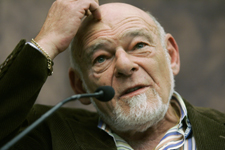
At Sam Zell's Chicago Tribune reporters and editors are being taught marketing and packaging, and serious stories are downplayed in favor of softer ones. (AP)
 |
Of course we'll have newspapers. But will there be any news in them?
COMMENTARY | December 01, 2008
James O’Shea, ex-editor of the LA Times, sees pandering to readers as a current danger and says newspapers aren’t going to solve their problems by lay-offs or closing bureaus. Journalists need to persuade people that we “once again are a public trust,” he writes.
By James O’Shea
jamesoshe@gmail.com
With all the reports about huge layoffs and financial troubles in the news business, it’s no wonder that many journalists and caring Americans question whether we will continue to have newspapers.
But those concerned about the fate of these fabled institutions are asking the wrong question. Of course we will have newspapers. Communist China has newspapers; Russia under the Soviets had newspapers. Serbia had newspapers under dictator Slobadan Milosevic.
The real question is what kind of journalism will we have in the newspapers that manage to survive the current wave of circulation and advertising declines plaguing the industry.
Will we have the rich, hard-hitting storytelling that gives the news its infrastructure of shoe-leather journalism from courthouses, police stations, legislatures and war zones, the kind of reporting that gives bloggers, broadcasters and others something to write and talk about?
Or will the surviving newspapers become vessels for “panderism” instead of journalism, flimsy content organized around the age-old principle of luring dog owners to stories in the paper so you can sell them some dog food?
I’ve been wondering about this question ever since I left the newsroom of the Los Angeles Times earlier this year over what has come to be commonly known as “a disagreement over the future direction of the paper.” But it really came home to me recently after I read Portfolio editor Joanne Lippman’s interview with Sam Zell, the real estate billionaire who seized control the company that owned the Times just before I was told it would be a good idea to spend more time with my family.
With his typical flair for controversy, Zell slammed newspapers BZ (Before Zell) for acting more like charitable trusts than businesses driven by the trusty capitalist principal of giving your investors something in return for their money.
“I think the newspaper industry truly still doesn’t understand that it is in a business with customers,” Zell told Lippman and others at a media conference, “and the business must reflect the needs and demands of the customer. And to the extent that we don’t do that, we will disappear.
“If you want to be a charitable trust, be a charitable trust,” he continued in a dismissive reference to Arthur Sulzberger’s New York Times. “But if you don’t want to be a charitable trust, then you’ve got to focus on producing a return for investors capital. It’s just that simple.”
I have a few problems with what Zell says. Sulzberger currently sells the New York Times, an excellent newspaper, for $1.50 a day, the same price that Zell’s acolytes are asking for four days of the Chicago Tribune in a special offer to win back readers who quit the paper after he took control. So I guess I would question who is running the “charitable trust.”
On the surface, though, much of what Zell says seems to make sense. There’s a pragmatic allure to his vision of challenging every newspaper cost and every decision through the prism of a cost-benefit analysis “just like our government is supposed to do when it raises our taxes.” Who would criticize him for suggesting we listen to our customers?
Speaking as someone who spent the last 30 years in a newsroom, I think he’s also probably right when he says journalists often refused to accept much responsibility for the industry’s declining readership and circulation problems, or that we cared more about our drive to excel journalistically than the serious problems in our business model.
The problem I have with Zell’s philosophy – and the questions it raises about the kind of journalism we will have in print and digital newspapers – is how that vision is applied in newsrooms he controls.
One of the journalistic Petri dishes for his experiments is the Chicago Tribune, a place, in the interest of full disclosure, where I worked for more than 25 years, including five in which I had the honor of being its managing editor.
The paper currently is in the throes of a massive redesign of its pages driven by people that Zell brought in from the radio industry to “reinvent” the daily newspaper.
Reporters and editors are being schooled in the art of marketing and packaging in an effort to reverse circulation declines at the paper and present “content” in new and visually arresting ways.
Instead of scanning the events, policies, tragedies and joys of the world and giving readers a balanced. in-depth, report on what is important, significant and interesting, editors now place a premium on stories that will appeal to “frenzied families” or “carefree couples.” These are categories of readers that the paper’s marketing studies suggest are turned off by reports of war, corruption and complex issues like financial calamity.
Accompanying the redesign were all-but-mandatory staff meetings run by a newly-minted masthead editor in which the paper’s journalists received lectures on how to reach their “target audiences” from a marketing department employee who long has tried to downplay serious, in-depth journalism in favor of softer stories that she insists readers really want. Write about disease, she told Tribune journalists, because that’s what “frenzied families” want to read about, not some bomb going off in Beirut.
What the Tribune is doing is like trying to improve education by replacing the teachers and giving the students only the books they want to read. I doubt it will happen, although the company is now out in the Chicago market aggressively discounting the price of the paper, presumably so it can claim victory in the months ahead.
In fairness, the Tribune points out in its written appeal to win back readers turned off by its new design that it still does serious journalism, citing three recent stories, including one on domestic violence. But the truth is the paper regularly produces fewer weighty stories on significant issues, and those that it does often are relegated to the confusing inside pages of the paper. At one news meeting, an investigative report on the Chicago Housing Authority (CHA) was rejected for page one because, as one ranking editor put it, the CHA “is not our demographic.”
As anyone who has spent any time in a newsroom can attest, reporters aim for stories that will land them on page one because that’s how they increase their journalistic capital, win the favor or their editors and enhance their careers. An editor who puts soft on page one will get plenty of soft.
In his remarks, Zell also took journalists and journalism to task for ignoring the desires of their readers. I spent many a day and night in my years as an editor talking to and interacting with hundreds of readers, something I really enjoyed.
Most often they were smart, thoughtful people who cared about the news and the future of our craft. Frankly, I never heard one of them tell me they wanted panderized pap in their newspaper organized around the principal of selling ads. They wanted news about the significant issues of the day organized and written in a way that helped them understand an increasingly complicated world.
There’s no question that we have some serious problems in our business, and from what I can determine, Zell and his aides do understand that revenue losses are a far bigger problem in the industry than readership. So even if they resolve the financial problems, reporters and editors will still face a thorny question about how we can practice journalism in the newspapers of the future, be they print and ink or digital.
If journalists want serious journalism to survive and thrive, journalists, and only journalists, will have to resolve the central problem we face: The public finds little economic value in what we do. Otherwise they would gladly pay for the news rather than rely on our increasingly unreliable partners in advertising to foot the bill.
Why is that? I don’t know, and, I would venture to add, I’d bet most other journalists don’t either, because few of us have looked very hard for an answer. This lack of intelligence about ourselves is understandable; newsrooms are busy places and few people have the luxury I’ve enjoyed over the past few months – some time to think.
I’ve come to realize that, as a journalist, I’ve not given enough real thought to how we got into this mess.
Zell says the newspaper industry’s problem is that it is living in the past, when its monopoly status allowed it to play the role of a public trust. “It worked in the old days,” he said, “because you could be a public trust and you could do well for your shareholders because you had a monopoly.” Now, he says, newspapers have to act like a business and do what their customers tell them.
The monopoly stuff may have been true about the classified ad business, where advertisers had few alternatives for reaching a mass market and little choice but to pay whatever rates newspapers charged them. But I had enough journalistic competitors on my heels to question his premise about the news side of the business. I really wonder, though, whether the problem we have is that simple.
If all we had to do was ask readers what they wanted in a newspaper and then give it to them, wouldn’t someone have done that years ago? Had they, and had they been successful, I can guarantee you everyone would have copied them and we would have no problem. Despite what Zell says, I’ve seen dozens of papers march down that road to no success.
I wonder if, contrary to Zell’s prescription, our problems aren’t related to our pursuit of our business interests at the expense of journalism.
It seems to me that the main problem journalism now faces is the lack of public trust in journalists. I don’t have to repeat the numerous studies that document the level of public esteem for journalists to be a cut above – or below – politicians and used car salesmen. And if people lack respect for you and your work, doesn’t it stand to reason that they don’t value what you do and won’t pay for it?
Why is public regard for journalists so low? There is no shortage of theories. Studies show that many disaffected people accuse journalists of political bias, an unfortunate if understandable view in a society that has become politically polarized over the last two decades, with people increasingly looking to print and television news to validate the opinions they already hold.
People tend to lump all media into one category, failing to differentiate between cable TV shoutfests, sensational celebrity-driven television, magazine and tabloid coverage and the more serious journalism traditionally practiced by established, big-city daily newspapers. To the extent we blur the differences between these once-distinct voices with pandering coverage that resembles advertorial and not editorial we play right into this trap.
I doubt there is any one reason that anyone can really point to for sure, but I suspect the lack of regard for our profession has something to do with the way we have operated as a business.
As Zell says, in the old days, we subordinated our goals for profit to our obligation to be a public trust. Newspaper families and owners remained intensely interested in profit, but not at the levels demanded once those families started selling out to professionally managed chains. As public esteem for journalists plunged, pressure from Wall Street to increase profits, often to unsustainable margins of 20 percent or more, also soared.
Newspapers did all sort of things to live up to Wall Street expectations over the years. They cut expenses, cut staff, eliminated sections of the paper and, like the Tribune Company, acquired other more profitable assets such as television stations.
Soon Tribune journalists, many only too willingly, started preening for the TV cameras and spouting their opinions and becoming minor celebrities. I really wonder how much that sort of thing, not only at Tribune Company but all over the nation, undermined our most precious asset, the integrity of our news reports.
Business considerations also drove the decision to give away content on the Internet. Once one news organization did it, almost all others followed. Is is any wonder that the public places little value on something that our own industry thought so little of that it gave it away for free?
Obviously, many other factors are no doubt involved. Any investigation of what went wrong would have to go far beyond a piece like this. The decline of readership is a complex problem that also involves sweeping social and cultural changes that have been given far too little attention and study. But if journalists don’t figure out how they got into this mess, they will never figure a way to get out. And that would be the true tragedy.
Contrary to the conventional wisdom, readership of newspapers is not really the problem. If you combine the print and on-line audiences of the Chicago Tribune or the Los Angeles Times, they both reach more readers than at any time in their history.
But the system that financed the news that they provide readers for less than the price of a cup of coffee is crumbling, and there’s nothing on the horizon to replace it.
At some point, readers are going to have to pay for the information, which will be a staggering change to the way we live and an even more fundamental change for journalists.
Newspapers across the country are not going to resolve that problem by laying off journalists, closing bureaus and even abandoning print editions for on-line papers. Tribune just slashed its Washington bureau severely at a time when interest in Washington is soaring because of a newly elected president from Chicago, Barack Obama. I suspect we will soon see newspaper bankruptcies.
Democracy, and indeed, Zell’s cherished capitalism, must have a vibrant and free press to survive and prosper. And you are not going to get that kind of press by simply listening to your customer and giving him what he or she wants. That’s what Detroit did when everyone told them they wanted an SUV. And look where that got them, and all of us.
I suspect that once again our future is at least in part in our past. To thrive and prosper, newspapers have to figure out how to deliver journalism that makes the public believe we once again are a public trust, something of value and something they won’t hesitate to pay for. Instead many papers today are trying to give readers entertainment, without the drama and without the laughs.
|
|
James O’Shea was the editor and executive vice president of the Los Angeles Times from 2006 to 2008 and held many high-level reporting and editing positions before that. 
E-mail: jamesoshe@gmail.com
|
Public perception of news
Posted by
Stephen Smoliar
12/01/2008, 01:00 PM
One reason why people fail "to differentiate between cable TV shoutfests, sensational celebrity-driven television, magazine and tabloid coverage and the more serious journalism traditionally practiced by established, big-city daily newspapers" may be that their television no longer exposes them to serious journalism. It has been downhill since CNN abandoned Headline News as a vehicle for delivering a basic summary every half hour in favor of turning it into a news-as-entertainment platform. Meanwhile, cable and satellite providers tend to ignore the few remaining sources of straight news, such as BBC World Service Television and Al Jazeera English. The result is a public with no interest in newspapers, since television no longer motivates that interest.
|
Adjunct journalism professor, DePaul University
Posted by
Joe Cappo
12/01/2008, 02:28 PM
Because the Tribune is sinking so rapidly after its latest makeover, Mr. O'Shea assumes that Sam Zell's analysis of the business was wrong. That is bad logic. Mr. Zell's initial critique of newspapers was mostly on target. However, the responses to that by those he installed to change it are mostly off target. Maybe it's because Zell's top guys are from the radio business, which is declining even more rapidly than newspapers at this point. One chronic problem with newspapers is that they are always trying to appeal to the young, a generation that has made it quite clear it has other primary news sources. In the process, newspapers have ignored the only audience that values newspapers: the mature, the affluent and the educated. Another chronic newspaper failing is the inability to change. Yes, we now have color weather charts (Whoopee!). But the newspaper of today looks remarkably like the newspaper of 50 years ago: crime and politics (reported as if the newspaper is the only source of news), columns for the lovelorn, turkey recipes, horse race results, gossip columns, comics, etc. I am amused by Mr. O'Shea's use of the loaded word "pander." Do you pander to readers when you produce a newspaper that people actually want to read? Isn't that what editors are supposed to do? The philosophy of the venerable Marshall Field & Co., a successful Chicago retailer for 150 or so years was always "give the lady what she wants." Is that "pandering" to customers? Or is it fulfilling the customer's needs and wants? Now that Macy's has snapped up Fields's, the old philosophy has been discarded, perhaps one reason Macy's is struggling. Let's face it, newspapers don't have a journalism problem. They have a marketing problem. They should identify audiences that are inclined to buy newspapers and give them something substantial to read. And they should vow to get out of the printing business and into the information business. As for Mr. Zell, the real estate tycoon, here is my take on it: If you acquired an old but valuable office building and wanted to enhance it for a profitable resale, would you break all of its windows, write graffiti on its facade and try to force all of the old tenants out? Probably not. But that's what you are doing to the Chicago Tribune.
|
Posted by
tm
12/01/2008, 02:30 PM
"Speaking as someone who spent the last 30 years in a newsroom, I think he’s also probably right when he says journalists often refused to accept much responsibility for the industry’s declining readership and circulation problems, or that we cared more about our drive to excel journalistically than the serious problems in our business model."
Having spent 30 years in a newsroom, O'Shea should realize that journalists were practically beaten over the head with the notion that we shouldn't be concerned with circulation or advertising or other business problems. The idea was that ANY attention to business matters would have led us down a slippery slope to pandering to advertisers or asking sources to buy subscriptions. Oversimplified, yes, but you get the point. The business side took care of the business, and we took care of the journalism. With 20/20 hindsight, it's easy to say journalists share the blame. Maybe we do. But at the time, the wall between the newsroom and the business side was seen as impenetrable.
I don't expect the Sam Zells of the world to understand that. He doesn't see anything that doesn't contribute directly to the bottom line as having any value (he'd do well to read John Bogle's book, "Enough," although I think the underlying message would be beyond his one-track, money-minded comprehension). That's the world he was brought up in. We were brought up in a different culture, which bottom liners and media haters are all to quick to condemn. Regardless of whether they're right or wrong, O'Shea should at least understand that.
|
MSN, Executive Producer
Posted by
Stephen Cvengros
12/01/2008, 02:43 PM
The angst that newspapers continue to wring their hands over is accepting that "information delivery" is their business. There is a zealousness about the format and a total miss on the audience.
Consider that reporters and editors are the premier news gatherers. In turn, consider that multiple news delivery mechanisms are the recipients of that information. Where newspapers are getting bogged down is the insistence to stay with that single form as primary delivery.
Instead, newsrooms need a total revamping to deliver not just to online, radio and TV, but to the actual entry points that the audience is interested in receiving info. The most obvious example is mobile.
But maybe more importantly is where the connection point begins and "what type of info" should be delivered. Consumers are delineating the differences faster than editors. They want real-time data that can travel with them (stock prices, sports scores, weather) while their interest in the "think pieces" still demands a more elongated experience of newspapers, magazines, even web.
And not all audiences want all of these "news types." They must be lured into believing there is value via highly relevant info delivered when/where/how they want it. As proof, consider that some of the most successful novels in Japan last year were written and read on cell phones. It was a younger audience of consumers declaring the direction of the medium.
Now that sounds painful to an old scribe or a hardened news editor. But riffing on the earlier statement: Give the consumer what they want. Sell them on what they're interested in. Then, convince them to get engaged with the valuable investigative work that preserves our rights and freedoms.
|
Posted by
jim
12/01/2008, 02:53 PM
A nit to pick, but I don't consider journalists to be "professionals." What we do is a craft. Until there is a test to pass like lawyers and doctors in order to practice, journalism will not be a profession but a craft.
|
Sponsor of Niemanwatchdog.org
Posted by
Murrey Marder
12/01/2008, 04:44 PM
Jim O'Shea has made a signal contribution to the multiple challenges confronting American Journalism today in all its fractured dimensions. If adversity is indeed the mother of invention,by now the combined shocks of revolutionary technology, unprecedented varieties of warfare, crippling economics, and a decade of bizarre politics, should have driven American journalism into a state of explosive, creative dynamism far earlier in this millenium. Instead, this nation's media, long the global pace-setter for democracy that truly held leaders accountable to their people, all but abandoned that mission in eight shameless years of the Bush administration. Many of us long in the tooth of journalism gritted what was left of them as the supine state of the American press unfolded year-by-painful year: In the mindless invasion of Iraq. Many most influential journals literally turned a blind eye on the monumental miscalculations of the nation's leaders. Baldly stated, the prime reason was spineless fear: fear of the public, fear of advertisers, and especially fear that the administration in power would so manipulate the nation that any criticism of the administration's extraordinary two-war policy would be equated with disloyalty--or even treason We in the press preach transparency and accountability, but we have been woefully delinquent in supplying the same criteria to ourselves. The outgoing administration leaves office with government-press relations in shambles: Instead of the press in a healthy watchdog role, the Bush administration can gloat that it left the press looking more like a whipped dog.
Above all, remind them--and ourselves--that "Power corrupts, and absolute power corrupts absolutely."
Jim O'Shea has set out precisely the right question for the American press and public and government to ask themselves. It is not "whether we will have newspapers," but "what kind of journalism will we have in the newspapers that manage to survive the current wave of circulation and advertising declines plaguing the industry."
This formulation could constructively be the launching pad for urging everyone who reads newspapers--or fails to read them--to reach into their own experience, their own knowledge, to put into writing what they wish such a newspaper--or television or radio station or news magazine to contain,that will fulfill the purposes of a vital American democracy.
|
Reader
Posted by
Richard McDonough
12/01/2008, 07:58 PM
I love my print, daily NYTimes, daily LATimes. The first is electronic via Kindle. The second hard copy in the driveway. I get great value from the NYT and less from the local Times that has some great writing and does the best it can with the handicap of Sam Z.
The business section is a consumer four to six pages, usually. More real business news in the Google headlines of the world. And no real writing there. The sixth largest economy in the world, California, gets 8-12 pp in its own section, including one page of weather and whatever ads the drummers could sweep up.
They inexplicably did an old crime series recently. Gosh, I could hardly wait for that to end.
Giving readers what they want, professor, quoting the Marshall Fields gang, is the worst kind of sophistry one can imagine. This is giving them what they will take because there is no other game n town.
Great writing, stories that are illuminating, reporting by people care about their beats (the LATimes has some top drawer writers...or did...hard to know since they don't run a list of redundancies...are what people who like newspapers want. Not what the Sams of the world can get away with. If you want crap, that's another thing. Easy to give the people who want the less than good with little staff and no imagination.
|
Retired attorney, former newsie
Posted by
Stan Wiggins
12/01/2008, 10:25 PM
A taxonomic nitpick, but seriously offered. Qualifying tests often suggest an effort to limit entry for economic purposes, as much as to protect the public. The worst of the Watergate and (potential) Bush felons were all professionals. I like the formula encountered some years ago: a professional is one who will not do some things for money, in both senses of that phrase. He will not prostitute his stake in the public trust (which the Founders would have called public virtue). He will do other, valued things, but will categorically refuse payment.
|
former reporter
Posted by
Steve Daley
12/02/2008, 11:48 AM
It's tough losing IQ points reading the great, mangled thoughts of Messrs. Zell and Abrams. But no one should get a pass, particularly those who sat around the Tribune editorial campfire in the pre-Zell era. Plenty of good folks disappeared and plenty of bureaus closed in the days of Jack Fuller, Howard Tyner and Jim O'Shea. Just to pick one: The pre-Zell Tribune sacked a talented defense and Pentagon reporter after the 1st Gulf War for the stated reason that the US was the lone superpower and, well, the Pentagon was out of business.
I could go on.
Newspapers lost their institutional faith long before the verbose likes of Zell and Abrams came along. Lots of reporters and editors saw it and they kept their mouths shut. What you're hearing now, sadly, is the death rattle.
|
former Trib employee
Posted by
kp
12/02/2008, 02:42 PM
O'Shea spent 30 years in Trib newsrooms and didn't spend enough time thinking about their future? Nice thoughts from a senior newsroom leader. No wonder he left such a mess at the Trib and the Times.
He strikes me as typical of many of the mediocre middle managers at the Trib who found themselves fat and happy during the salad days, and then ill equipped to handle the real problems that came along. He also sounds like a weasel - passing along snide comments from his friends still in the Tribune newsroom, slamming those who are attempting to do something about the massive challenges the paper is facing (without contacting the editor and marketing manager he sneers at, didn't he learn something about getting both sides in his 30+ years in newsrooms?)
Last - did he actually use the term "shoe leather"?.....
|
Former newspaperman, grim realist
Posted by
Keefer21
12/04/2008, 05:20 PM
Umm, for those who are confused about the "future of newspapers" please pay attention: -- large and medium-sized daily newspapers will either go under or will become "niche products," and will no longer suffice as mass-market vehicles for text-based news; weekly community newspaper will survive just fine, thank you. -- large daily newspapers will go out of business or get much, much smaller because there is no logical business model that supports one of the most wasteful and inefficient platforms for delivering textual news ever invented; from deforesting part of Nova Scotia each day, bleaching the paper pulp, using internal combustion machines driven by Teamsters to breathlessly deliver a product with the shelf-life a fruit fly. Why, oh why should any journalist lament the fact that the business model is broken? That's like saying you wish there was no internet, or Google; and don't take it personally O'Shea, it has nothing to do with you. The problem is you still think journalists have some say in the matter. Not so. -- large daily newspapers will go away or shrink but journalists and journalism will do quite well in this new arena. If O'Shea thinks there will no new digital muckraking and "thought pieces" because there are no more analog newsrooms, then he really does not get anything that's happening right now. -- most consumers will not pay for textual information on a subscription basis; they haven't paid for advertiser-supported TV and radio news (including CBS' 60 Minutes), why should they pay for advertiser-supported textual news (ad-supported news websites) now? -- they stopped using exquisitely crafted buggy whips in the early 20th Century not because they weren't beautiful, or useful, or because people didn't need to be transported rapidly over ground; they stopped using buggy whips because they didn't need that particular mode of transportation. And they won't need things called daily newspapers, but they will need textual news and they'll have plenty to choose from. -- Lastly, Zell just hasn't figured out he's going to lose his shirt. Death spirals -- even for newspapers -- are tough to watch.
|
coupon book
Posted by
Bettina Kozlowski
12/11/2008, 04:53 PM
The redesign that was so euphemistically pitched by the Tribune's new marketing-uhm-managing editor as a fresh look "giving readers what they want" resulted in a very nice coupon book! But why waste precious space and cut a sixteenth of a page from the wine-and superstore-blowout sales ads! Do we really need an eighty-word "headline story" in the national section purchased from AP? That fussy AP is too expensive and it's not "news you can use." I suggest renaming the Trib's sections"National Coupon Section" and "Local Coupon Section" and the business section "Cooking For Less." You want local community newspaper? At 25 cents a copy, the Chicago Tribune is just that! It'll compete well with The (bankrupt)Reader, because its owner has no ambition and now no money left to squeeze from layoffs to hire an Evan Osnos as its international correspondent. Want a gripping account of how Ukraine and Poland are competing to be part of the new Europe? Just read it online! What’s that, yahoo doesn’t send journalists abroad? I feel cynical and helpless as I watch the work of great journalists, such as Mr. Osnos, fade into atavistic irrelevance, thanks to the attitudes of great businessmen, like Mr.Zell. Oh, I know of great offers to spruce up websites pro-bono, or work as an unpaid intern for the Tribune. Lately, I have also fielded part-time, corporate job offers for editor with a salary range from $13 to $16 an hour, "depending on experience…” I propose It's time for a collective career change for all journalists: We'll join the stuffed ranks of MBAs, CEOs, executives et al to further our own economic interests, instead of clinging to the vestiges of idealism with the surefire prospect of a steadily deteriorating, substandard quality of life. Though I for one cherish leaving my house and computer behind once in a while and pulling out my NYT - the real thing, made of recycled paper!- on a park bench,bus or in a long checkout line. I love reading well crafted sentences that convey new insight and opinion that arouses my passions in a way no pundit on cable news, or no yahoo article could ever do. By respecting my intelligence and giving me more than I expected. Too bad those of us who think sponsoring an Evan Osnos to reveal what's going on farther than 30 miles away through his home-away-from-home lens, are over. Excuse me, "must loop outta hear", as I have ten more coupons to cut out from the Trib and study the P/E ratios of industrials!
|